


Environmental health experts at Flinders University have found open windows and ventilation can reduce but not completely remove methamphetamine contamination on most hard surfaces of a car after an extended period.
In a new study, researchers tested various parts of a car’s interior to show concentrations in the air and surfaces exposed to controlled release of methamphetamine smoke. While levels generally dropped over time, the experts warn indirect exposure could still occur, in particular in textile or soft surfaces.
The latest results, published in the journal Forensic Chemistry, highlight the complexity of managing meth contamination in contained spaces where various fabric types showed differing levels of meth smoke taint – even after eight weeks of ventilation.
“Redistribution of methamphetamine can occur, and remediation attempts may be hampered by methamphetamine ‘stored’ in non-surface material including the air-conditioning unit, upholstery, and underlying foam,” says lead author Gemma Kerry, from Flinders University’s College of Science and Engineering.
“And some fabric concentrations appeared to slightly increase after venting for a total of eight weeks. This may have occurred because of relatively high temperatures reported inside the car during the venting period, volatilising the drug and resulting in transfer.”
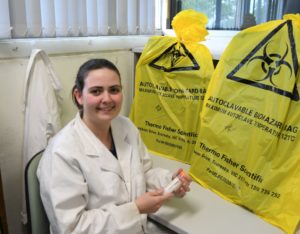
Lead author, PhD in Forensic Chemistry and Environmental Health Gemma Kerry, is investigating levels and subsequent risk to other people’s health of meth contamination left on household upholstery, underlying foam and even air-conditioning units.

Senior researcher Professor Kirstin Ross adds: “Testing and remediation for methamphetamine in contaminated vehicles, residences and elsewhere is important to protect public health.
“This latest data on methamphetamine distribution from smoking and ventilation could aid in further investigation of contamination and remediation in cars.
“Individuals exposed to indirect contamination may have adverse health symptoms including respiratory problems, headaches and behavioural and cognitive issues.”
This makes it important to determine the overall methamphetamine contamination extent of cars to provide the public with safeguards when buying or using vehicles, the Flinders University experts conclude.
Under a special licence, the Flinders University team used controlled emissions of methamphetamine smoke in a car with no known prior contamination.
After three smoking events, there was a general concentration increase on the car surfaces, on four fabric types placed on the car seat and seat backrests, and in the sampled air.
The highest surface concentrations were reported from the driver’s overhead – likely due to rising smoke.
The highest methamphetamine concentrations were observed from cotton and faux leather, with the lowest concentrations from polyester and neoprene fabrics. For cotton, faux leather, and neoprene fabrics generally lower concentrations were reported from the seat back when compared to the seat.

Air concentrations ranged from 0.19 to 0.96 micrograms per cubic metre (μg/m3) in the driver area and the rear storage area after three controlled smokes.
Air testing detected small amounts of methamphetamine in the air. By comparison, tobacco smoke could contain hundreds of thousands of micrograms per cubic metre of airborne particles in indoor environments.
After the contaminated car’s windows were opened for decontamination purposes, the concentrations in the air and on the surfaces generally decreased after venting for a total of eight weeks after the last smoking event.
The Flinders University research will help law enforcement agencies, vehicle dealerships, vehicle lenders and owners faced with testing and cleaning contaminated vehicles, in particular stolen or second-hand cars.
The new article, ‘Controlled smoking of methamphetamine in a car and initial remediation by ventilation: Analysing air, surfaces and fabrics’ (2026) by Gemma L Kerry, Kirstin E Ross, Jackie Wright and G Stewart Walker was published Forensic Chemistry DOI: 10.1016/j.forc.2025.100723.
All testing activities were done with Flinders University Risk Assessment and Safe Work Procedure and under Government of South Australia Research, Instruction, Training or Analysis Permit (Controlled Substances Act, 1984 Permit Number: 2024-83442).